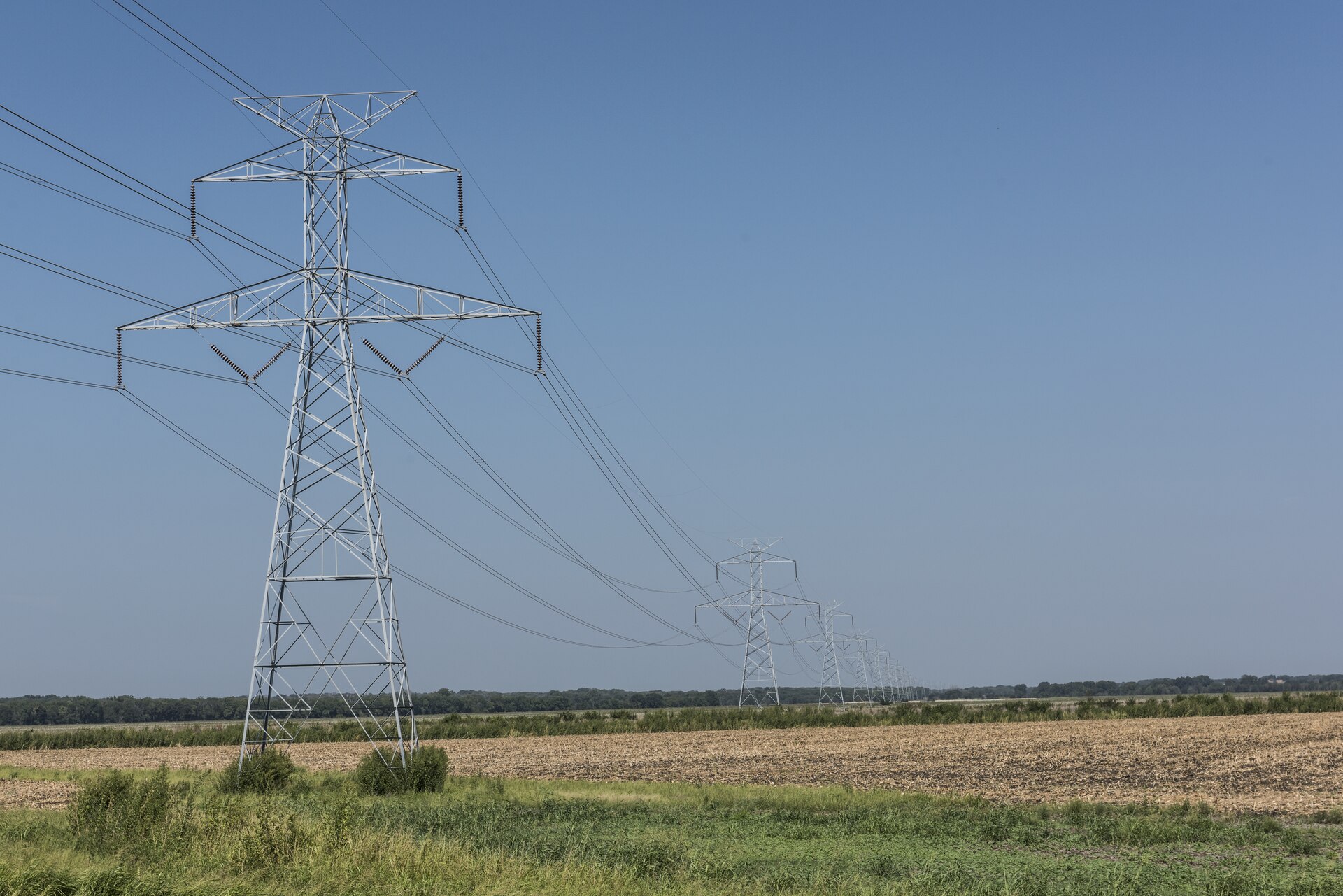
High-voltage transmission towers and power lines in Ellis County, Texas. Photo: Carol M. Highsmith, Library of Congress, via Wikimedia Commons. License: Public domain.
Quick Answer: ERCOT’s December 2026 resource adequacy outlook puts the chance of a grid emergency during the riskiest hour, 8 a.m. on a December morning, at 2.95%. That is below ERCOT’s 10% elevated-risk level but above the 1.81% projected for December 2025, and a severe storm could push load to 78,000-90,000 MW, near or above the 80,560 MW winter record.
Texas goes into the 2026-27 winter with far more generating capacity than a year ago, a weatherization inspection program now in its sixth winter, and a fuel-backup service under contract through mid-March. The Electric Reliability Council of Texas (ERCOT) also expects morning demand on winter days to keep rising. Much of the new capacity is solar, which produces little or nothing in the dark hours when winter risk peaks.
What does ERCOT’s December 2026 outlook say about winter grid risk?
ERCOT’s Monthly Outlook for Resource Adequacy (MORA) is a monthly probabilistic look at whether there will be enough supply to meet demand. Each report is targeted for release on the first Friday of the month, two months before the month it covers. The December 2026 report was posted in early October 2026. It simulates combinations of weather, demand, renewable output and plant outages to estimate how often reserves would fall far enough to trigger an Energy Emergency Alert (EEA).
For December 2026, ERCOT puts the highest EEA risk in the hour ending 8 a.m. Central Standard Time, with a probability of 2.95%. ERCOT treats risk above 10% as elevated. The report says that under typical conditions “there should be sufficient generating capacity available” in that hour. Risk is lower in the evening: the riskiest evening hour, 7 p.m., carries a 1.12% EEA probability.
ERCOT says morning risk rises compared with November because colder temperatures increase heating load. The 50th-percentile peak load forecast for the 8 a.m. hour is 75,148 MW, and the model assumes 12,001 MW of thermal generation will be out for planned or unplanned reasons.
How does this winter compare with last winter’s outlook?
Compared with the December 2025 MORA, both supply and demand grew, yet projected risk rose.
| Metric | December 2025 MORA | December 2026 MORA |
|---|---|---|
| Highest-risk hour | 8 a.m. CST | 8 a.m. CST |
| EEA probability in that hour | 1.81% | 2.95% |
| Peak load forecast for that hour (50th percentile) | 71,664 MW | 75,148 MW |
| Reserve margin (deterministic, typical conditions) | 54.1% | 45.6% |
| Natural gas installed capacity | 67,998 MW | 69,555 MW |
| Coal | 13,705 MW | 13,705 MW |
| Nuclear | 5,268 MW | 5,268 MW |
| Wind | 40,629 MW | 40,820 MW |
| Solar | 34,500 MW | 40,812 MW |
| Energy storage (batteries) | 14,735 MW | 21,136 MW |
| Hydro | 579 MW | 579 MW |
Source: ERCOT, Monthly Outlook for Resource Adequacy reports for December 2025 and December 2026. Capacity figures are installed operational resources.
Between the two reports, installed solar grew by about 6,300 MW and battery storage by about 6,400 MW. Natural gas added roughly 1,560 MW. Wind, coal and nuclear barely moved. Forecast morning demand for the riskiest hour rose by about 3,500 MW, and the reserve margin under typical conditions fell by 8.5 percentage points.
What changed between the November and December 2026 reports?
The November 2026 MORA put the riskiest hour at 7 p.m., with a 3.40% EEA probability, a 65,446 MW load forecast and a 65.2% reserve margin. In December, peak risk moves to the morning as heating demand rises. December’s report also shows winter-rated capacity up 969 MW from November: 900 MW of solar, 166 MW of wind and a 97 MW decrease in storage, with no change in gas.
Why is a winter morning the hardest hour for the Texas grid?
The December MORA shows how much of the installed fleet is actually available in that hour. Dispatchable resources make up 58% of installed capacity, and thermal dispatchable resources alone make up 46%. At 8 a.m. in December, dispatchable resources supply 83% of available capacity, because solar is at or near zero before sunrise and wind output varies.
The low-wind cases show the exposure. In ERCOT’s probabilistic model, the minimum wind output scenario for December is 1,795 MW and the 5th-percentile outcome is 4,216 MW, out of about 40,800 MW of installed wind. On those mornings, gas, coal, nuclear and stored battery energy carry almost all of the load.
How high could demand go in a severe winter storm?
The December MORA includes a winter storm simulation with load between 78,000 MW and 90,000 MW. ERCOT calls the 90,000 MW outcome “remote.” For comparison, the official ERCOT winter peak record is 80,560 MW, set February 20, 2025, during Winter Storm Kingston. That beat the 78,349 MW record from January 16, 2024, during Winter Storm Heather. ERCOT’s all-time peak, from any season, is 85,508 MW on August 10, 2023.
| Benchmark | Value | Date / context |
|---|---|---|
| Winter peak demand record | 80,560 MW | Feb. 20, 2025 (Winter Storm Kingston) |
| Previous winter record | 78,349 MW | Jan. 16, 2024 (Winter Storm Heather) |
| December peak record | 74,525 MW | December 2022 (Winter Storm Elliott) |
| Winter Storm Fern instantaneous peak (unofficial) | 75,922 MW | January 2026; not a record |
| All-time peak demand (any season) | 85,508 MW | Aug. 10, 2023 |
| December 2026 storm simulation range | 78,000-90,000 MW | December 2026 MORA |
| December 2025 battery discharge record | 9,737 MW | Dec. 23, 2025 |
Source: ERCOT peak demand records, ERCOT monthly reports, ERCOT Board system operations update, and the December 2026 MORA. Recent records may be revised in final settlement.
What did Winter Storm Fern reveal about grid readiness?
The most recent test was Winter Storm Fern, which hit Texas January 23 to 26, 2026. ERCOT’s operational review says the grid stayed stable, with enough generation and reserves and no widespread outages, and ERCOT never entered EEA Level 2. The maximum unofficial instantaneous demand was 75,922 MW, below the winter record. ERCOT estimated the Monday morning, January 26, peak at about 84,558 MW after adding back demand that large customers curtailed. That shows how much demand response held the metered peak down.
The storm also showed where the system is vulnerable. ERCOT reported about 13.5 GW of installed wind unavailable because of icing, although the actual lost output was smaller because wind speeds were low too. At the metered peak, wind supplied 6,777 MW and solar 3,167 MW. Gas curtailments in North Texas and operational flow orders on pipelines led ERCOT to use 340 MW of Firm Fuel Supply Service to keep affected units running. ERCOT also obtained U.S. Department of Energy emergency orders under Section 202(c) and enforcement discretion from the Texas Commission on Environmental Quality so generators could run at maximum output.
Batteries played a bigger role in operations. ERCOT reported that lower demand and stronger wind on the evening of January 25 meant less battery discharge, leaving more stored energy for the next morning’s peak, the same morning window that the December 2026 MORA flags as the riskiest.
How do Texas weatherization rules and inspections work this winter?
The PUCT’s weather emergency preparedness rule, 16 Texas Administrative Code Section 25.55, adopted after Winter Storm Uri, sets the requirements. Generation entities and transmission service providers must finish their winter weather preparation measures by December 1 each year. Each must file a declaration of winter weather preparedness between November 1 and December 1. The rule defines the winter season as December 1 through the end of February.
The required measures must be “reasonably expected to ensure sustained operation” at the 95th-percentile minimum average 72-hour wind chill for the facility’s location. ERCOT must inspect every interconnected generation resource at least once every three years. For transmission, it must use a risk-based method to choose at least 10% of substations or switchyards and inspect them at least once every three years.
What happens when a power plant fails an inspection?
If ERCOT finds deficiencies, it issues a written report and sets a cure period. If problems are not fixed in time, ERCOT reports the entity to PUCT staff for enforcement. The rule makes a violation a Class A violation, with penalties of up to $1,000,000 per violation per day. After a repeated or major weather-related forced outage, the owner must hire a qualified professional engineer to assess its weatherization program.
How many inspections has ERCOT completed?
In an October 22, 2026 presentation, ERCOT’s director of weatherization and inspection said the program had completed 5,330 inspections of generation and transmission facilities through summer 2026. He described compliance as high among market participants with well-developed programs. The same presentation cited ERCOT internal analyses finding that peak forced outage rates for dispatchable generation fell by more than 40% on average in post-Uri storms compared with storms of similar severity from 2011 through 2021.
What backup fuel arrangements are in place for 2026-27?
ERCOT’s Firm Fuel Supply Service pays generators to keep units available if natural gas is curtailed or fuel supply is otherwise disrupted. The 2026-27 obligation period runs from November 15, 2026, through March 15, 2027. Offers were due September 1, 2026, and ERCOT said it would notify awarded sellers by September 30.
What does ERCOT’s long-term load forecast mean for future winters?
The winter outlook covers a few months. ERCOT’s 2026 long-term load forecast covers years. The preliminary forecast, filed April 15, 2026, projected peak demand of about 278,003 MW in 2029 and about 367,790 MW by 2032, more than four times the current all-time peak. It includes requests from medium loads (25 to 74.9 MW) and large loads (75 MW and above), such as industrial facilities and oil and gas processing.
ERCOT CEO Pablo Vegas said at release that “we believe this forecast to be higher than expected future load growth.” ERCOT stressed that the forecast is a planning snapshot and “not a prediction of what will be built.” On May 18, 2026, ERCOT asked the PUCT to adjust the forecast used in transmission and resource adequacy studies and recommended a method it called Batch Zero, which it said gives a firmer basis for expected load. The proposal was filed in PUCT Project No. 59772.
| Winter 2026-27 readiness snapshot | Detail |
|---|---|
| Weatherization deadline | Dec. 1, 2026 (declarations due Nov. 1-Dec. 1) |
| Cumulative ERCOT weatherization inspections | 5,330 through summer 2026 |
| Maximum penalty for uncured violations | Up to $1,000,000 per violation per day |
| Firm Fuel Supply Service period | Nov. 15, 2026-Mar. 15, 2027 |
| December 2026 peak-hour EEA probability | 2.95% (8 a.m. CST) |
| 2032 preliminary peak forecast | About 367,790 MW (adjustment proposed) |
Source: PUCT rule 16 TAC Section 25.55, ERCOT weatherization presentations, ERCOT Firm Fuel Supply Service notices, ERCOT December 2026 MORA, and ERCOT market notices.
Brian’s Take
As a former investment manager, I look at the gap between the averages and the tails, and this winter’s numbers show both. A 45.6% reserve margin and a 2.95% emergency probability look comfortable. But the storm simulation runs from 78,000 MW to 90,000 MW, and the actual winter record is 80,560 MW. The cushion that matters is the one available on a dark, icy morning, and the largest additions this year were solar, which produces nothing at that hour, and batteries, which can only discharge what they stored.
Winter Storm Fern is the evidence I’d give Texas businesses. The grid held, with no Level 2 emergency, but it relied on large customers cutting demand, emergency federal orders, firm fuel contracts and batteries saving their charge for the morning. That’s a system that is managed well, not one with spare capacity to burn. Companies with big winter-morning loads should assume they may be asked to curtail during the next cold snap and plan their operations around that.
The weatherization program looks like a real success: 5,330 inspections, penalties up to $1 million a day, and forced outages down more than 40% in comparable storms. What I’d watch next is how the PUCT handles the long-term forecast. Even ERCOT’s CEO says 367,790 MW is too high, and the adjusted number will shape transmission spending that every ratepayer funds.
Frequently Asked Questions
What is ERCOT’s emergency risk for December 2026?
ERCOT’s December 2026 MORA estimates a 2.95% probability of an Energy Emergency Alert in the riskiest hour, 8 a.m. CST. ERCOT considers risk above 10% elevated.
What is the ERCOT winter peak demand record?
The official winter record is 80,560 MW, set February 20, 2025, during Winter Storm Kingston. Winter Storm Fern in January 2026 reached an unofficial 75,922 MW, which was not a new record.
When must Texas power plants finish winterizing?
Under PUCT rule 25.55, generation entities and transmission providers must complete winter preparation measures by December 1 and file a readiness declaration between November 1 and December 1.
Why is winter risk highest in the morning?
Heating load peaks on cold mornings before solar output begins, so the grid relies mainly on gas, coal, nuclear, wind and stored battery energy. At 8 a.m. in December, dispatchable resources make up 83% of available capacity.
Is Texas demand really expected to quadruple by 2032?
ERCOT’s preliminary 2026 forecast projected about 367,790 MW by 2032. ERCOT’s CEO said the forecast is likely higher than actual growth will be, and ERCOT has proposed adjustments to the PUCT.
Sources and Further Reading
- Monthly Outlook for Resource Adequacy, December 2026 — ERCOT
- Monthly Outlook for Resource Adequacy, November 2026 — ERCOT
- Monthly Outlook for Resource Adequacy, December 2025 — ERCOT
- 2025 Peak Demand Records — ERCOT
- ERCOT Monthly Report, February 2025 — ERCOT
- ERCOT Monthly Report, January 2026 — ERCOT
- System Operations Update (Winter Storm Fern), February 2026 Board materials — ERCOT
- Director’s Corner: Weatherization and Inspection, October 2026 — ERCOT
- 16 Texas Administrative Code Section 25.55, Weather Emergency Preparedness — Public Utility Commission of Texas
- Firm Fuel Supply Service program page and Market Notice M-C073126-01 — ERCOT
- ERCOT Releases Preliminary Long-Term Load Forecast for 2026-2032 — ERCOT
- Market Notice M-B051826-01 on Long-Term Load Forecast Adjustments — ERCOT