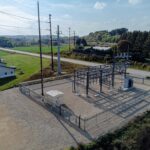
Photo: Yana Petkova / Unsplash, Unsplash License
Quick Answer: Texas wires utilities are spending at record levels. Oncor plans about $9.0 billion of capital in 2026 within a $47.5 billion 2026-2030 base plan. AEP Texas closed a federal loan of up to $3.26 billion for transmission upgrades, and TNMP settled its first rate review in seven years. Ratepayers are seeing the cost through rate cases and the new Unified Tracker Mechanism at the Public Utility Commission of Texas.
The transmission and distribution utilities (TDUs) that own the poles, wires and substations in ERCOT’s competitive areas are in the middle of the largest spending cycle in their history. The drivers are customer growth, large industrial and data center load, the Permian Basin, and storm and wildfire hardening ordered after recent disasters. This report looks at Oncor, AEP Texas and Texas-New Mexico Power (TNMP): how much they plan to spend, what the Public Utility Commission of Texas (PUCT) has approved, and what reaches customer bills. CenterPoint Energy Houston Electric, the other large TDU, is outside the scope of this piece.
How big are the Texas wires utilities?
| Utility | Customers | Footprint |
|---|---|---|
| Oncor Electric Delivery | 4.155 million delivery points (Q3 2026) | More than 145,000 circuit miles |
| AEP Texas | About 1.12 million | About 97,000 sq. mi.; 45,726 distribution and 8,609 transmission line miles |
| TNMP | More than 280,000 | Service areas across Texas; based in Lewisville |
Oncor is the largest by far. It reported 4,155,000 distribution points of delivery at the end of the third quarter of 2026, up 1.3% from a year earlier. It added more than 65,000 premises in 2025, about 13,400 in the first quarter of 2026 and about 14,400 in the third quarter. AEP Texas’s 2024 fact sheet lists 1,122,118 customers across 93 counties and 375 cities and towns in South and West Texas. TNMP serves more than 280,000 homes and businesses.
How much is Oncor spending?
Oncor announced a $47.5 billion base capital plan for 2026 through 2030 in February 2026. That was about $11.4 billion more than its prior five-year plan. The increase included $6 billion for remaining Permian Basin Reliability Plan projects, $2 billion for other new transmission, $2 billion for distribution upgrades and $1 billion for Delaware Basin load integration. Oncor also listed about $10 billion of potential additional work outside the base plan.
| Year | Oncor base capital plan |
|---|---|
| 2026 | About $9.0 billion |
| 2027 | About $10.0 billion |
| 2028 | About $10.1 billion |
| 2029 | About $9.4 billion |
| 2030 | About $9.0 billion |
| Total | About $47.5 billion |
Execution is on pace. Oncor spent $6.28 billion in the first nine months of 2026 toward a roughly $9.0 billion budget, which it calls the largest annual plan in its history and about 25% above 2025 spending. In its November 5 earnings release, Oncor said it expects its 2027-2031 base plan to be about 20% larger, with details due in the first quarter of 2027.
What is driving Oncor’s spending?
Large-load demand is the headline. At the end of the third quarter, Oncor had 795 large commercial and industrial transmission interconnection requests. Those included about 293 GW from data centers and about 19 GW from other industrial sectors. Customers had posted about $6.0 billion of collateral. Oncor’s own system set a peak of 33.3 GW on August 24, 2026, up from 31.4 GW in 2025. In April, it submitted forecasts to ERCOT of 122 GW of large load and 5.2 GW of medium load through 2036. Requests are not commitments, and much of that queue may never be built. Even so, Oncor filed 16 new certificate of convenience and necessity (CCN) applications for transmission lines in 2026 and has had eight of them approved.
The physical work is steady. Oncor built, rebuilt or upgraded nearly 700 circuit miles in the first quarter and more than 700 in the third, after about 3,100 in 2025.
What did the PUCT approve in Oncor’s rate case?
On April 17, 2026, the PUCT approved an unopposed settlement of Oncor’s comprehensive base rate review in Docket No. 58306. Key terms:
| Item | Approved |
|---|---|
| Revenue increase | About $560 million over 2024 test year (about 8.7%) |
| Return on equity | 9.75% |
| Capital structure | 56.5% debt / 43.5% equity |
| Cost of debt | 4.94% |
| New rates effective | June 1, 2026 (interim from Jan. 1 with surcharge) |
| Residential impact | About 3% a month at 1,000 kWh |
The results show up in earnings. Oncor’s third-quarter distribution base revenues rose 28.6% from a year earlier to $1.18 billion. Net income reached $572 million for the quarter and $1.21 billion for the first nine months, up from $820 million in the same period of 2025.
What is the Unified Tracker Mechanism?
Texas House Bill 5247, passed in 2025, created a new way for TDUs to recover capital between rate cases. Oncor describes the Unified Tracker Mechanism (UTM) as a single annual proceeding that combines the distribution cost recovery factor and the transmission cost recovery factor. Oncor says that means fewer rate adjustments during the year. It also says the UTM’s updated cost allocation shifts costs toward fast-growing large commercial and industrial customers.
What did each utility ask for under the UTM?
Oncor filed its first UTM request in April 2026 in Docket No. 59249. It covers about $4.4 billion of net capital placed in service in 2025 and seeks about $550 million of net revenue. Oncor estimates a residential bill increase of about $3.85 a month, or about 2.5%, at 1,000 kWh. UTM revenue rose to $139 million in the third quarter from $36 million a year earlier.
AEP Texas filed the first UTM application in October 2025, and the process has been bumpy. In March 2026, an administrative law judge recommended a partial disallowance based on a later effective date for eligible deferrals. AEP Texas argued that position did not reflect HB 5247’s legislative intent. In May, the PUCT chairman issued a memo agreeing with the judge, and AEP recorded a $23 million pretax charge. AEP’s third-quarter release listed a $22 million year-to-date earnings impact from the probable partial disallowance.
TNMP filed its UTM application on September 1, 2026. It seeks $77.9 million in distribution cost recovery revenue requirements and $27.0 million in transmission cost of service requirements for July 2025 through June 2026.
How is AEP Texas funding its grid buildout?
In July 2026, AEP Texas closed a loan of up to $3.26 billion from the U.S. Department of Energy’s Energy Dominance Financing Program. The money funds about 100 projects to rebuild, reconductor or build more than 2,800 miles of transmission lines. DOE says many projects will double the power-carrying capacity of existing lines and help serve data centers and Permian Basin oil and gas operations. DOE estimates that AEP Texas’s 1.1 million customers will save about $685 million in electricity costs over 30 years.
Parent American Electric Power raised its five-year capital plan to $100 billion for 2027 through 2031 in October 2026. That includes about $37 billion for transmission and about $22 billion for distribution across its 11-state system. AEP does not break out a Texas-only figure in that release. AEP Texas had collected about $223 million in cumulative revenue from interim transmission and distribution rate increases through June 30, 2026. Those increases remain subject to review in a future base rate case.
What is in AEP Texas’s resiliency and wildfire plans?
On April 24, 2025, the PUCT approved an unopposed settlement of AEP Texas’s three-year, roughly $318 million system resiliency plan. About 80% of the spending replaces aging assets with equipment built to higher standards. The rest covers targeted vegetation management and situational awareness technology. AEP Texas projects the plan will prevent about 1.3 billion minutes of customer interruptions and save about $71 million in restoration costs. The company says its territory, from the Panhandle to the Rio Grande Valley, has the largest coastal exposure of any Texas utility.
On August 24, 2026, AEP Texas filed a wildfire mitigation plan with the PUCT. It covers risk-based inspections, extra vegetation management in high-risk areas, possible disabling of automatic reclosing, and Public Safety Power Shutoffs in extreme conditions. If approved, it would take effect in January 2027. Oncor’s own wildfire plan, filed under House Bill 145, has a PUCT staff recommendation for approval, with a decision expected in the fourth quarter of 2026.
What is happening at TNMP?
On August 3, 2026, TNMP announced a comprehensive settlement of its 2026 rate review in Docket No. 58964 with consumer groups, cities, large customers and PUCT staff. It was TNMP’s first rate filing in seven years and raises delivery rates by about 1%. The settlement recovers $20.5 million of Hurricane Beryl restoration costs over five years and includes debt refinancing protections tied to acquisition commitments. TXNM Energy said base rate relief, cost-recovery factors and HB 5247 revenues helped lift third-quarter earnings.
Ownership is changing too. Blackstone agreed in May 2025 to acquire TXNM Energy for $61.25 a share. The PUCT approved a unanimous settlement in February 2026. New Mexico regulators have hearings set for January and February 2027, and the deal is expected to close in the first half of 2027.
What does the spending mean for Texas customers?
Three cost layers are stacking up for Oncor customers: the base rate increase that took effect in June, a pending UTM increase of about 2.5% and separate resiliency plan revenue. Oncor’s resiliency plan revenue reached $176 million in the first nine months of 2026, up from $111 million. For AEP Texas, the disallowance shows the PUCT is willing to read the new tracker law narrowly. TNMP’s roughly 1% increase is the smallest of the three, but it also has the smallest system.
Brian’s Take
The numbers that stand out to me are Oncor’s pace of 700-plus circuit miles a quarter and its roughly $6 billion in customer collateral. Utilities don’t usually get large customers to post that kind of money unless the demand is serious. At the same time, 293 GW of data center requests is a huge number next to a 33 GW system peak. Texas businesses should treat the queue as a sign of interest, not a load forecast.
The regulatory story is just as important. The PUCT gave Oncor a 9.75% return and a faster recovery tool through the UTM. It then trimmed AEP Texas’s first tracker filing on a technical reading of the law. I read that as the Commission saying yes to growth spending while watching the details. For a business planning its electricity budget, delivery charges are going up in steps. Oncor’s base rate increase is about 3% for a typical home, and its UTM request is another 2.5% or so. Plan for more of those steps as these capital plans move through rate cases.
The AEP Texas federal loan is the piece I’d watch most closely. DOE estimates $685 million of savings over 30 years. If cheaper financing like that spreads, it is one of the few levers that lowers the cost of this buildout instead of just spreading it out.
Frequently Asked Questions
How much is Oncor spending on capital in 2026?
About $9.0 billion, the largest annual plan in its history, within a $47.5 billion 2026-2030 base plan. It spent $6.28 billion through September.
What return on equity did the PUCT approve for Oncor?
9.75%, with a 43.5% equity ratio and a 4.94% cost of debt, in an order issued April 17, 2026.
What is the Texas Unified Tracker Mechanism?
It is an annual PUCT proceeding created under HB 5247 (2025). It combines transmission and distribution cost recovery factors so utilities can recover new capital between full rate cases.
How many customers does AEP Texas serve?
About 1.12 million across 93 counties in South and West Texas, according to the company’s 2024 fact sheet.
Did TNMP raise rates in 2026?
TNMP settled its first rate review in seven years for a delivery rate increase of about 1%. The settlement includes $20.5 million of Hurricane Beryl cost recovery over five years.
Sources and Further Reading
- Oncor Reports Third Quarter 2026 Results — Oncor Electric Delivery
- Oncor Reports First Quarter 2026 Results — Oncor Electric Delivery
- Oncor Reports 2025 Results, Announces $47.5 Billion 2026-2030 Base Capital Plan — Oncor Electric Delivery
- Oncor Files Unified Tracker Mechanism Request to Support Reliability — Oncor Electric Delivery
- AEP Reports Third Quarter 2026 Earnings, Expands Capital Plan — American Electric Power
- Form 10-Q, Rate Matters (quarter ended June 30, 2026) — American Electric Power, U.S. Securities and Exchange Commission
- AEP Texas to Execute Three-Year Plan to Boost Resiliency — American Electric Power
- 2024 AEP Texas Fact Sheet — AEP Texas
- EDF Project: AEP Texas — U.S. Department of Energy Loan Programs Office
- AEP Texas Files Wildfire Mitigation Plan with Texas Regulators — T&D World
- TNMP Reaches Settlement on New Electric Delivery Rates — TNMP
- TXNM Energy Reports Third Quarter 2026 Results — TXNM Energy