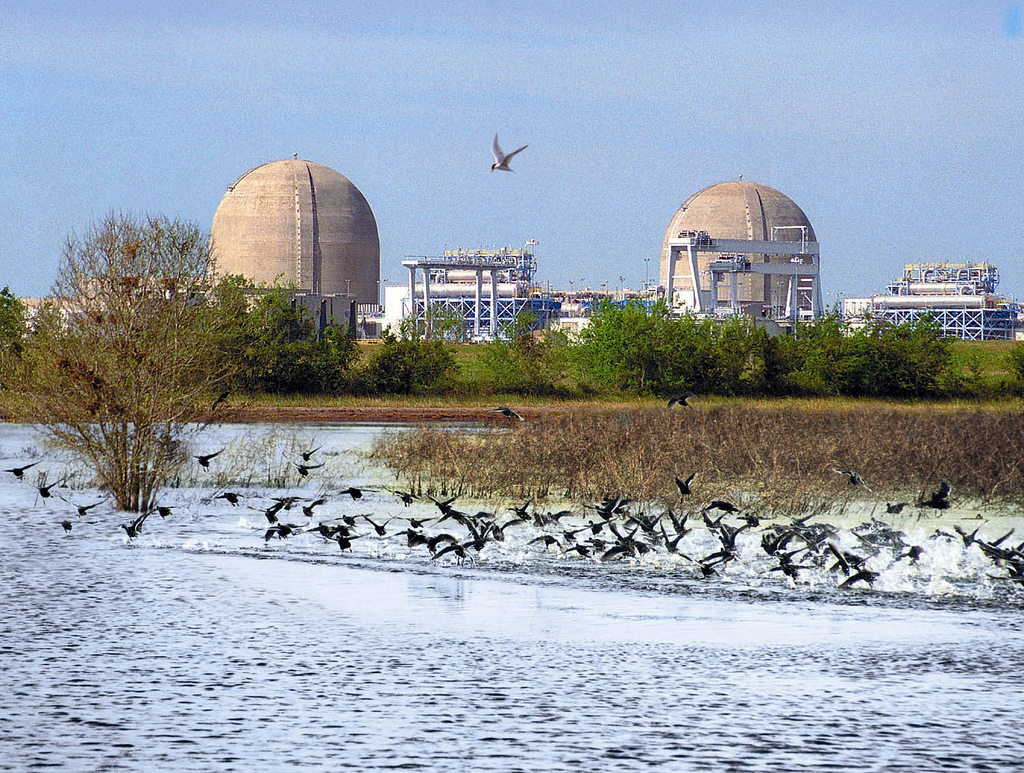
Reactor containment buildings at the South Texas Project nuclear plant in Matagorda County. Photo: U.S. Nuclear Regulatory Commission, via Wikimedia Commons. License: Public domain.
Quick Answer: Texas has two operating nuclear plants, Comanche Peak and the South Texas Project, with 5,268 MW of installed capacity on the ERCOT grid. Under House Bill 14, the state created the Texas Advanced Nuclear Energy Office and a $350 million fund to help pay for new reactors. As of November 2026, the leading new project is Dow and X-energy’s four-reactor Long Mott plant at Seadrift, which received an NRC construction permit on November 9, 2026.
For more than three decades, nuclear power in Texas has meant four large reactors at two sites. They supply a steady share of the state’s electricity but have not been joined by new ones. That is starting to change. In 2025 the Legislature created a state office to promote advanced nuclear energy and backed it with $350 million in reimbursement grants. In 2026, the U.S. Nuclear Regulatory Commission (NRC) and the U.S. Department of Energy (DOE) moved several Texas projects forward, from a Gulf Coast chemical plant to the Panhandle.
What is the Texas Advanced Nuclear Energy Office?
The Texas Advanced Nuclear Energy Office (TANEO) was created by House Bill 14, authored by Rep. Cody Harris and Sen. Charles Schwertner, passed by the 89th Legislature, and signed by Gov. Greg Abbott in June 2025. The bill placed the office inside the Office of the Governor. It followed recommendations from the Texas Advanced Nuclear Reactor Working Group, which Abbott directed the Public Utility Commission of Texas to form in 2023.
According to the governor’s office, TANEO is meant to provide strategic leadership for the advanced nuclear industry, promote advanced reactors as a source of dispatchable electricity, support the nuclear supply chain and high-wage manufacturing jobs, and serve as a single point of contact for developers working through state permitting. Jarred Shaffer was named TANEO director in September 2025.
How much money is in the Texas Advanced Nuclear Development Fund?
HB 14 created the Texas Advanced Nuclear Development Fund with $350 million. The governor’s office has called it the largest commitment of its kind in the country. TANEO runs the fund through two reimbursement programs. Applications opened April 1, 2026. Notices of intent were due April 23, and full applications were due May 14, 2026.
| Program | Total funding | Per-project cap | Key eligibility and uses |
|---|---|---|---|
| Advanced Nuclear Construction Reimbursement Program | Up to $280 million | $120 million | Requires an NRC construction permit or license application docketed by Dec. 1, 2026 (or a reasonable expectation of one); covers NRC review, long-lead components, construction, manufacturing and testing; no personnel costs |
| Project Development and Supply Chain Reimbursement Program | Up to $70 million | $12.5 million | Open to businesses, nonprofits, governments and universities; covers technology development, feasibility studies, site planning, early site permit work, license preparation, fuel processing and fabrication |
Source: Office of the Texas Governor, TANEO request for applications FAQ; Utility Dive. Caps apply per advanced nuclear project, not per company.
The program FAQ sets the timeline. The first award period could begin as early as September 14, 2026. Funds must be encumbered by August 31, 2027, and no grant period can extend past August 31, 2029. Utility Dive reported that recipients were expected to be selected in July 2026. The program documents reviewed for this article did not list individual award amounts.
Why do only a few projects qualify for construction money?
Few developers have filed formal construction applications with the NRC. In April 2026, Shaffer told the American Nuclear Society’s Nuclear Newswire: “We’ve only got two eligible projects in the state that check that docketed box.” Those two were Dow’s Long Mott project and Fermi America’s Project Matador. Abilene Christian University has a docketed NRC permit, but it is not eligible for the construction program because it already received $120 million in state support. It can still apply for development and supply chain funding.
How much power do Comanche Peak and the South Texas Project produce?
Texas has two nuclear plants, each with two pressurized water reactors. ERCOT’s December 2026 resource adequacy report lists 5,268 MW of installed nuclear capacity. That compares with 69,555 MW of natural gas. ERCOT data reported by EnergyCapital put nuclear at about 8% of the energy on the ERCOT grid in 2025, the same as in 2024.
| Plant | Location | Capacity | Ownership | License expiration |
|---|---|---|---|---|
| Comanche Peak Units 1 and 2 | Somervell County, about 40 miles southwest of Fort Worth | About 2,400 MW (two units) | Vistra | Unit 1: Feb. 8, 2050; Unit 2: Feb. 2, 2053 |
| South Texas Project Units 1 and 2 | Matagorda County, about 90 miles southwest of Houston | 2,645 MW (two units) | Constellation 44%, CPS Energy 40%, Austin Energy 16% | 2047 and 2048 |
Source: U.S. Nuclear Regulatory Commission; U.S. Energy Information Administration; Constellation Energy; POWER magazine; Texas Public Radio.
How long can the existing plants keep running?
Comanche Peak Unit 1 began operating in 1990 and Unit 2 in 1993. On July 30, 2024, the NRC renewed both operating licenses for another 20 years, so the units can run until 2050 and 2053. The South Texas Project received 20-year extensions in 2017, which moved its expirations from 2027 and 2028 to 2047 and 2048. In 2023, Constellation Energy completed its purchase of NRG Energy’s 44% stake in the South Texas Project, a deal announced at $1.75 billion.
The fleet also supports a sizable workforce. The Comptroller counted 1,694 jobs in nuclear utilities and generation in 2022, with an average wage of $175,140, and more than 3,000 nuclear-related jobs once manufacturing, construction and professional services are included. A Texas 2036 analysis published in June 2026 found that Texas plants have supplied about 5% of U.S. nuclear generation for more than 25 years, and that Texas ranked seventh among states in nuclear generation in 2025.
Which advanced reactor projects are planned in Texas, and where do they stand?
Only two projects have formal NRC applications for commercial-scale plants. The others are a research reactor, pre-application efforts, or projects using DOE’s separate authorization pathway.
| Project | Site | Technology and size | Licensing status (November 2026) |
|---|---|---|---|
| Long Mott Generating Station (Dow, X-energy) | Seadrift, Calhoun County | Four Xe-100 gas-cooled reactors, 80 MWe each, 320 MWe total plus process steam | NRC construction permit issued Nov. 9, 2026; operating license still required |
| Project Matador (Fermi America, with Texas Tech) | Carson County, near Amarillo | Four AP1000 reactors, about 4.4 GW | Combined license under NRC review; draft environmental impact statement out; final expected early 2027 |
| MSR-1 (Natura Resources, Abilene Christian University) | Abilene | 1 MWt molten salt research reactor | NRC construction permit Sept. 16, 2024; now pursuing DOE authorization; DOE safety design agreement approved in 2026 |
| Texas A&M RELLIS reactor park | Bryan | Multiple advanced reactors, 10 to 1,000 MWe each | NRC pre-application for an early site permit |
| Last Energy | Haskell County | Up to 30 pressurized water reactors, 20 MWe each | NRC pre-application |
Source: U.S. Nuclear Regulatory Commission; American Nuclear Society Nuclear Newswire; Engineering News-Record; Nuclear Engineering International; NRC project pages.
What does the Long Mott construction permit mean for Seadrift?
Dow filed its construction permit application for Long Mott in March 2025. The NRC issued the permit on November 9, 2026, within the agency’s 18-month review target, after an environmental finding of no significant impact earlier in 2026. The plant would use four of X-energy’s Xe-100 high-temperature gas-cooled reactors, each rated at 80 MWe and 200 MWt, to supply electricity and high-temperature steam to Dow’s UCC Seadrift Operations site. The project has about $2.15 billion in cost-shared funding from DOE’s Advanced Reactor Demonstration Program.
The permit does not authorize operation. Dow still has to finish engineering and design, win approval from its board, and obtain an NRC operating license before loading fuel. The American Nuclear Society reported that a preliminary investment decision is expected in 2027, that construction could start later this decade, and that commercial operation is targeted for the early 2030s.
Where does Fermi America’s Amarillo project stand?
Fermi America, working with Texas Tech University, plans four Westinghouse AP1000 reactors totaling about 4.4 GW at its Project Matador site near the Pantex plant in Carson County. The company submitted the first portion of its combined license application on June 17, 2025, and the NRC accepted parts of it for review on September 5, 2025. Under an NRC pilot, the applicant prepares the environmental impact statement under NRC supervision. An NRC letter dated October 8, 2026, said the draft environmental impact statement was available and that the agency expects to issue the final version early next year. Engineering News-Record reported that Fermi America is targeting construction in 2027 and commercial operation of the first unit in 2033. The site also holds a state air permit for 6 GW of natural gas generation.
Why did Abilene Christian’s reactor move to a DOE pathway?
Abilene Christian University obtained an NRC construction permit on September 16, 2024, for a 1 MWt molten salt research reactor developed with Natura Resources. In December 2025, Natura signed an Other Transaction Agreement with DOE to seek authorization under the department’s Reactor Pilot Program instead of an NRC operating license. In July 2026, DOE approved a Nuclear Safety Design Agreement for the reactor, the first step on that pathway. DOE requires a preliminary safety analysis report before major construction and a final safety analysis report before fuel loading. Natura plans to use data from the reactor in NRC licensing of its 100 MWe MSR-100 commercial design, which it is developing with Texas A&M.
What is happening at Texas A&M’s RELLIS campus?
The Texas A&M University System is in NRC pre-application work for an early site permit at its RELLIS campus in Bryan, intended to host multiple advanced reactors. The NRC project page, last updated in September 2026, still lists the effort as pre-application, with an early site permit submittal planned for the fourth quarter of 2025. In February 2025, the system announced that Kairos Power, Natura Resources, Terrestrial Energy and Aalo Atomics could locate reactors there. In June 2026, Terrestrial Energy signed ground lease and research agreements for about 77 acres at RELLIS for its Integral Molten Salt Reactor, rated at 392 MWe and 882 MWt.
Which other Texas nuclear projects are early-stage?
Last Energy is in NRC pre-application for up to 30 small 20 MWe pressurized water reactors in Haskell County. Atomic Alchemy’s Groves isotope test reactor and Aalo Atomics’ Austin facilities have DOE backing but had not formally begun NRC licensing when the state fund opened. Texas 2036 counts at least three Texas-based projects in DOE’s Reactor Pilot Program.
What does the nuclear push mean for Texas energy markets?
For comparison, the entire $350 million state fund is smaller than the roughly $2.15 billion federal cost share at Long Mott, and the state’s construction grants are capped at $120 million per project. The program reimburses projects that already have federal licensing momentum. Announced timelines put new commercial capacity in the 2030s: early in the decade for Long Mott and 2033 for Project Matador’s first unit. Meanwhile, the licenses of the existing plants run into the 2040s and 2050s. Dow’s expected 2027 investment decision at Seadrift is the next major milestone.
Frequently Asked Questions
How much is the Texas Advanced Nuclear Development Fund?
The fund holds $350 million: up to $280 million for construction reimbursement, capped at $120 million per project, and up to $70 million for project development and supply chain work, capped at $12.5 million per project.
How many nuclear power plants operate in Texas?
Two: Comanche Peak in Somervell County and the South Texas Project in Matagorda County. Each has two reactors, and ERCOT lists 5,268 MW of installed nuclear capacity.
Has any new commercial reactor in Texas received an NRC permit?
Yes. The NRC issued a construction permit for Dow and X-energy’s four-unit Long Mott Generating Station at Seadrift on November 9, 2026. An operating license is still required.
What share of ERCOT electricity comes from nuclear?
About 8% of ERCOT’s energy in 2025, according to ERCOT data reported by EnergyCapital, unchanged from 2024.
When could Fermi America’s Amarillo reactors be licensed?
The NRC published a draft environmental impact statement in fall 2026 and expects the final version in early 2027. The company targets construction in 2027 and first-unit operation in 2033.
Sources and Further Reading
- About TANEO — Office of the Texas Governor
- Governor Abbott, TANEO Boost Advanced Nuclear Construction — Office of the Texas Governor
- Governor Abbott Touts Texas Fueling the Nuclear Renaissance, Booming Energy Sector — Office of the Texas Governor
- FAQs for the Texas Advanced Nuclear Development Fund Request for Applications — Office of the Texas Governor
- Texas Opens $350M Advanced Nuclear Grant Program — Utility Dive
- Texas Opens $350M in Nuclear Funding — American Nuclear Society Nuclear Newswire
- With a $350M Nuclear Fund Approved, Texas Wants Projects to Fill It — Engineering News-Record
- NRC Issues Construction Permit for Dow/X-energy Long Mott Project — American Nuclear Society Nuclear Newswire
- Letter on Draft Environmental Impact Statement for Project Matador, October 8, 2026 — U.S. Nuclear Regulatory Commission
- NRC Renews Comanche Peak Operating Licenses (News Release 24-062) — U.S. Nuclear Regulatory Commission
- Texas Nuclear Profile — U.S. Energy Information Administration
- Constellation Completes Acquisition of Ownership Stake in Texas Nuclear Plant — Constellation Energy
- NRG Energy to Sell Texas Nuclear Plant Stake to Constellation — POWER magazine
- STP Nuclear Power Plant License Extended — Texas Public Radio
- Nuclear Overview — Texas Comptroller of Public Accounts
- Texas’ Reliable Nuclear Power Generation, 2000-2025 — Texas 2036
- Abilene Christian University and Texas A&M University System project pages — U.S. Nuclear Regulatory Commission
- Natura Executes an OTA with the DOE — American Nuclear Society Nuclear Newswire
- Natura Receives MSR Safety Approval — Nuclear Engineering International
- Terrestrial Energy and Texas A&M Reach Agreement on Reactor Siting — American Nuclear Society Nuclear Newswire
- Monthly Outlook for Resource Adequacy, December 2026 — ERCOT