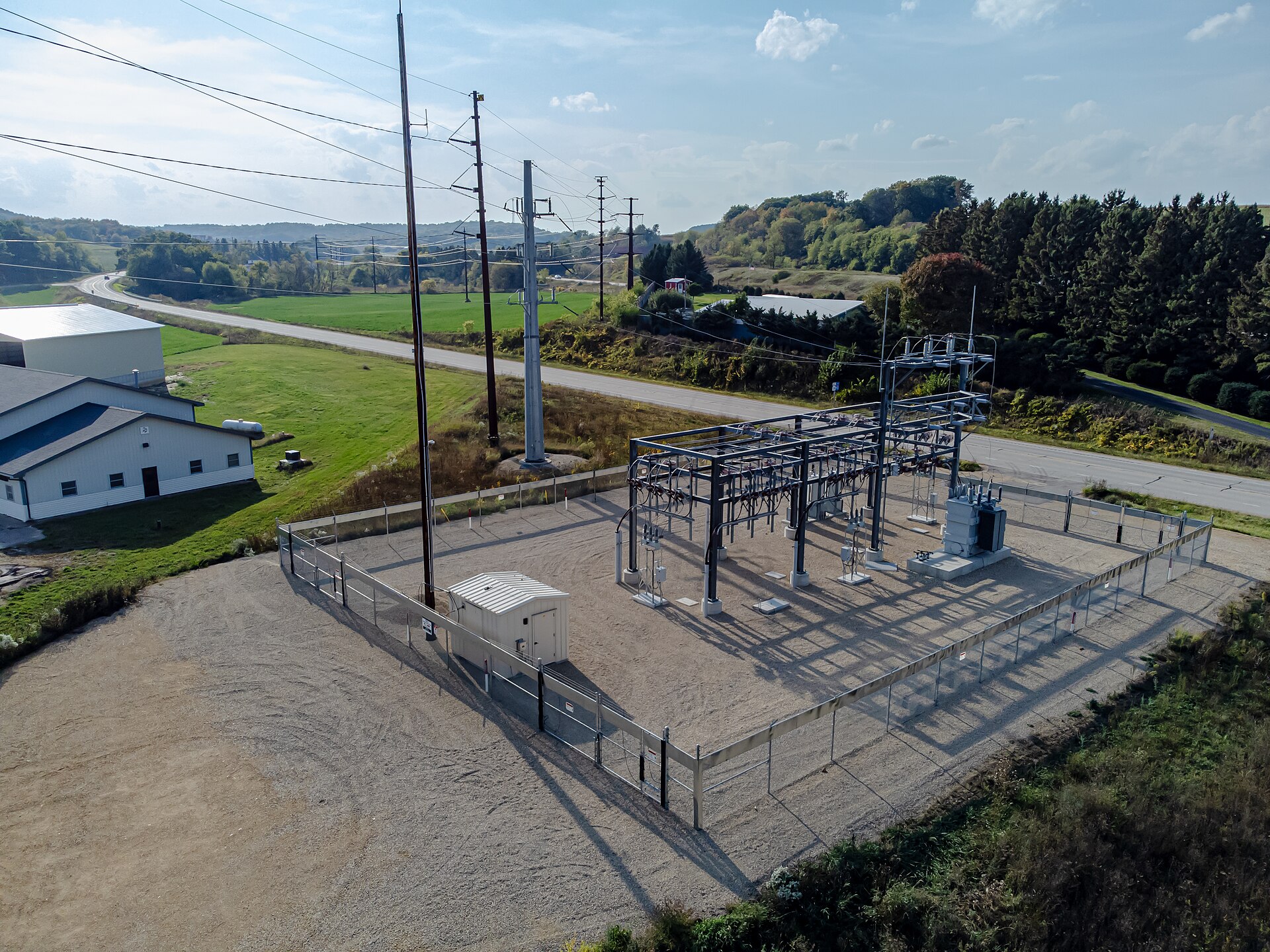
An electrical substation. Source: Wikimedia Commons (Small electrical substation.jpg). License: CC0.
Quick Answer: ERCOT’s Real-Time Co-optimization plus Batteries (RTC+B) market redesign went live on December 5, 2025, and now buys energy and ancillary services together every five minutes. ERCOT projected savings of more than $1 billion a year but has not yet published realized savings; that assessment is due to its board in February 2027. Early data show low ancillary service prices and lower hub prices than a year earlier, along with over-procurement of Non-Spin reserves and lower battery revenues.
Almost a year after the biggest change to the Texas wholesale power market since the nodal market launched in 2010, the first results are in. ERCOT, the Electric Reliability Council of Texas, switched on Real-Time Co-optimization plus Batteries, known as RTC+B, on December 5, 2025. ERCOT CEO Pablo Vegas called it the most substantial enhancement to the real-time nodal market design since its inception. This report explains what changed and what ERCOT, its independent market monitor and industry analysts have reported since.
What is RTC+B?
RTC+B changes how ERCOT buys the reserves that keep the grid stable. Before the change, ancillary services such as regulation and reserves were procured largely in the day-ahead market, and real-time dispatch could not easily reassign them. Under RTC+B, ERCOT’s real-time dispatch engine, known as SCED, co-optimizes energy and ancillary services together every five minutes and can move reserve obligations to whichever resources can provide them most cheaply at that moment.
According to ERCOT, the redesign:
- Co-optimizes energy and ancillary services in real time, with SCED reassigning resources to meet ancillary service needs.
- Models battery storage as a single device rather than as a generator plus a load, and considers state of charge for both energy and ancillary services.
- Replaces what ERCOT called inefficient supplemental markets with real-time ancillary service procurement.
- Reduces the need for out-of-market commitments.
The project began in 2019 under a directive from the Public Utility Commission of Texas (PUCT), following a cost-benefit assessment, and was later expanded to include batteries as storage grew on the grid. The PUCT had directed ERCOT and the independent market monitor to assess the benefits of real-time co-optimization in 2017, and the monitor released its report in June 2018. ERCOT’s 2025 annual report says the system was deployed six months ahead of schedule.
| Go-live date | December 5, 2025 |
| Projected savings (ERCOT) | More than $1 billion per year in wholesale market costs |
| Dispatch interval | Every five minutes |
| Pricing curves | Ancillary Service Demand Curves (ASDCs) for Reg-Up, Reg-Down, RRS, ECRS and Non-Spin, replacing the single ORDC |
| System-wide offer cap | Reduced from $5,000/MWh to $2,000/MWh after go-live |
| PUCT project | Project No. 48540 |
| Realized-benefits report | Due to ERCOT Board, February 2027 |
How does scarcity pricing work under RTC+B?
The redesign replaced the Operating Reserve Demand Curve (ORDC), the single scarcity adder that had raised prices when reserves ran low, with five Ancillary Service Demand Curves (ASDCs), one each for Regulation Up, Regulation Down, Responsive Reserve Service (RRS), ERCOT Contingency Reserve Service (ECRS) and Non-Spinning Reserve (Non-Spin). The curves were derived from a historical aggregate ORDC using a blended method created by Nodal Protocol Revision Request (NPRR) 1268.
A second rule change, NPRR1269, added a $15 per MW per hour shortage floor for ECRS and Non-Spin, and a proxy offer floor for resources that do not submit ancillary service offers, set at the lesser of $2,000 per MW per hour or the ASDC price at 95% of the ancillary service plan. ERCOT also reduced the system-wide offer cap from $5,000 per MWh to $2,000 per MWh after go-live, according to its Summer 2026 market review.
How much has RTC+B saved?
ERCOT has not yet put a dollar figure on realized savings. Its November 2026 biennial report on the ORDC and ASDCs states that ERCOT will present an assessment of realized RTC+B benefits to its Board in February 2027. When it launched the system, ERCOT Vice President of Commercial Operations Keith Collins said the projected wholesale market savings exceed $1 billion annually. An earlier ERCOT study estimated $2.5 billion to $6.4 billion a year in reduced energy costs.
What is available now is a set of operating results and price comparisons.
What happened to ancillary service prices?
ERCOT’s biennial report covering December 5, 2025 through September 30, 2026 found median ancillary service clearing prices of $0.03 to $0.62 per MWh for Reg-Up, Reg-Down, RRS and ECRS, and $0.25 per MWh for Non-Spin. Shortages, intervals in which SCED cleared less than the ancillary service plan, were rare: 2.03% of intervals for Non-Spin, 0.12% for ECRS and 0.03% for RRS. They were concentrated on spring and early-summer evenings, mostly in May and June.
ERCOT’s independent market monitor, Jeff McDonald of Potomac Economics, told ERCOT’s Technical Advisory Committee in August 2026 that shortage pricing through the ASDCs has been minimal since implementation. ERCOT’s Summer 2026 review, presented to the board in September by Dan Woodfin and Keith Collins, described summer ancillary service costs as relatively low and said total energy plus ancillary service costs were close to or slightly below summers 2024 and 2025. Day-ahead ancillary service prices were lower than in 2024 and 2025 for every service except Non-Spin.
| Market | Before RTC+B | After RTC+B | Change |
|---|---|---|---|
| Real-time (SCED) | $30.20 | $26.69 | -11.6% |
| Day-ahead | $30.99 | $26.19 | -15.5% |
Source: Yes Energy analysis comparing the first six months of RTC+B with the prior-year period, excluding Winter Storm Fern. Gas prices and weather also affect these changes.
Did wholesale energy prices fall?
An analysis by Yes Energy published in July 2026 compared the first six months of RTC+B, December through June excluding Winter Storm Fern, with the same months a year earlier. Hub-average real-time prices fell 11.6% to $26.69 per MWh from $30.20, and day-ahead prices fell 15.5% to $26.19 from $30.99. The spread between day-ahead and real-time prices narrowed by about 50%, and the number of qualified scheduling entities participating in virtual ancillary service trading rose from about 5 a day to about 18. These are analyst figures, and natural gas prices and weather also drove price changes over the period.
ERCOT’s Summer 2026 review also reported that real-time congestion rent was 10% below summer 2025 and said RTC played a role.
What problems surfaced after go-live?
The launch was not without issues. ERCOT’s February 2026 Commercial Markets Update reported a December 6 day-ahead software issue affecting energy storage resources; prices were corrected before becoming final on December 8. From December 5 through 10, some real-time ancillary service trades were not passed to settlements, and those prices were not corrected. The biennial report identified a SCED solver issue that ran from December 5, 2025 to January 7, 2026 and was fixed on January 8. In July 2026, ERCOT found model errors that had understated its 2026 ECRS and Non-Spin quantities; ERCOT reported no reliability issues as a result.
Why is ERCOT over-buying Non-Spin?
The largest inefficiency so far involves Non-Spin reserves. From go-live through September 30, 2026, median Non-Spin procurement was 148.29% of the ancillary service plan, and awards exceeded the requirement in 91.3% of intervals. Total Non-Spin cost over the period was $59.2 million, of which $12.5 million, or 21.1%, paid for capacity above the requirement. ERCOT’s report notes that this figure is not a savings figure. Yes Energy cited the market monitor’s December 2025 report as attributing the over-procurement to ancillary service duration requirements and ASDC characteristics.
Non-Spin bought above plan rose from about 25 GWh per day in June to about 48 GWh per day in July and August 2026, according to the Summer 2026 review.
What does RTC+B mean for out-of-market commitments?
The results here are mixed. In December 2025, Reliability Unit Commitment (RUC) resource-hours fell to 129.9, down 67% from November and about 45% below December 2024, and 67% of December’s RUC hours came before go-live. For full-year 2025, RUC hours were about 5,300, compared with about 2,000 in 2024. In summer 2026, RUC hours rose to 1,313, from 872 in summer 2025 and 148 in summer 2024; ERCOT said the increase was mainly to secure ancillary services.
| Summer | RUC Resource-Hours |
|---|---|
| 2024 | 148 |
| 2025 | 872 |
| 2026 | 1,313 |
How has RTC+B affected battery storage?
Batteries are at the center of the redesign. ERCOT says about 16,000 MW of battery storage was synchronized from 2021 through 2025. The Summer 2026 review found that the energy storage capacity offered into real time rose substantially in 2026 and that batteries’ share of ancillary service awards grew. On the lowest state-of-charge days, average state of charge in summer 2026 was about 50% lower than in 2025; state of charge was below 20% in 15% of hours and below 10% in 0.74% of hours.
More competition for reserves has lowered battery revenues. Modo Energy reported in June 2026 that average battery revenue in March 2026 was $1.88 per kW-month, 23% below the trailing 12-month average of $2.43, after $1.16 per kW-month in February. Ancillary service revenues fell $0.52 per kW year over year in March, and the May 2026 real-time top-bottom spread fell 60% to $40 per MWh.
The biennial report also found that peaker net margin remained consistent through the switch from the ORDC to the ASDCs, an important signal for investors in dispatchable generation.
How did RTC+B perform during Winter Storm Fern?
The first real stress test came in January 2026. ERCOT’s February Commercial Markets Update reported that during Winter Storm Fern, real-time ancillary service prices ran below day-ahead ancillary service prices, at times significantly. That is the pattern the redesign was meant to produce: when conditions tighten, real-time co-optimization can shift reserve duties among available units instead of relying only on what was committed the day before. The Yes Energy before-and-after price comparison excluded the storm period.
What does RTC+B mean for Texas businesses that buy power?
Most commercial and industrial customers never see ancillary service charges directly, but those costs flow through to retail rates and contract prices. Three early results matter for buyers.
Lower average prices. The Yes Energy comparison found hub-average real-time prices down 11.6% and day-ahead prices down 15.5% in the first six months, though fuel costs and weather contributed.
Less volatility between markets. The spread between day-ahead and real-time prices narrowed by about half. Smaller spreads make it easier for retail providers and large buyers to hedge, which can reduce the risk premiums built into fixed-price contracts.
Minimal scarcity pricing. The market monitor said shortage pricing through the new curves has been minimal, and the 2025 ORDC adder averaged just $0.02 per MWh before the switch. Scarcity pricing is the main source of extreme price spikes, so its rarity limits exposure for customers on index-based contracts.
The offsetting costs are the Non-Spin over-procurement and higher RUC hours, both of which are charged to the market. ERCOT’s February 2027 report should show how those costs net against the savings.
What comes next for the ERCOT market?
- February 2027 benefits report. ERCOT’s board will receive the first assessment of realized RTC+B savings.
- ASDC changes. On August 20, 2026, the PUCT indicated that the ASDCs no longer must be derived from the aggregate ORDC, with discussion expected in PUCT Projects 48540 and 59550.
- DRRS. Dispatchable Reliability Reserve Service, a legislatively required ancillary service for dispatchable generation, is still being designed, with options under review for moderate and high load-growth scenarios.
- Non-Spin procurement. Changes to duration requirements or curve design could reduce the over-procurement identified in the biennial report.
Frequently Asked Questions
When did RTC+B start?
ERCOT launched RTC+B on December 5, 2025.
How much will RTC+B save Texans?
ERCOT projected more than $1 billion a year in wholesale market savings. Its first assessment of realized benefits is due in February 2027.
Did power prices fall after RTC+B?
A Yes Energy analysis found hub-average real-time prices down 11.6% and day-ahead prices down 15.5% in the first six months versus a year earlier, though fuel prices and weather also played a role.
How does RTC+B affect batteries?
Batteries are now modeled as single devices and compete in real time for ancillary services. Their share of awards rose, but Modo Energy data show lower average battery revenues in early 2026.
What is the biggest issue identified so far?
Non-Spin over-procurement: awards exceeded requirements in 91.3% of intervals, and $12.5 million of $59.2 million in Non-Spin costs paid for capacity above the requirement.
Sources and Further Reading
- ERCOT Goes Live with RTC+B – Electric Reliability Council of Texas
- 2026 Biennial Report on ORDC and Initial Report on ASDC – Electric Reliability Council of Texas
- Summer 2026 Operational and Market Review – Electric Reliability Council of Texas
- Commercial Markets Update, February 2026 – Electric Reliability Council of Texas
- 2025 ERCOT Annual Report – Electric Reliability Council of Texas
- ERCOT Trending Topic: RTC+B – Electric Reliability Council of Texas
- 2025 State of the Market Presentation to TAC – Potomac Economics
- 6 Months in Review: ERCOT RTC+B – Yes Energy
- ERCOT BESS Benchmark – Modo Energy