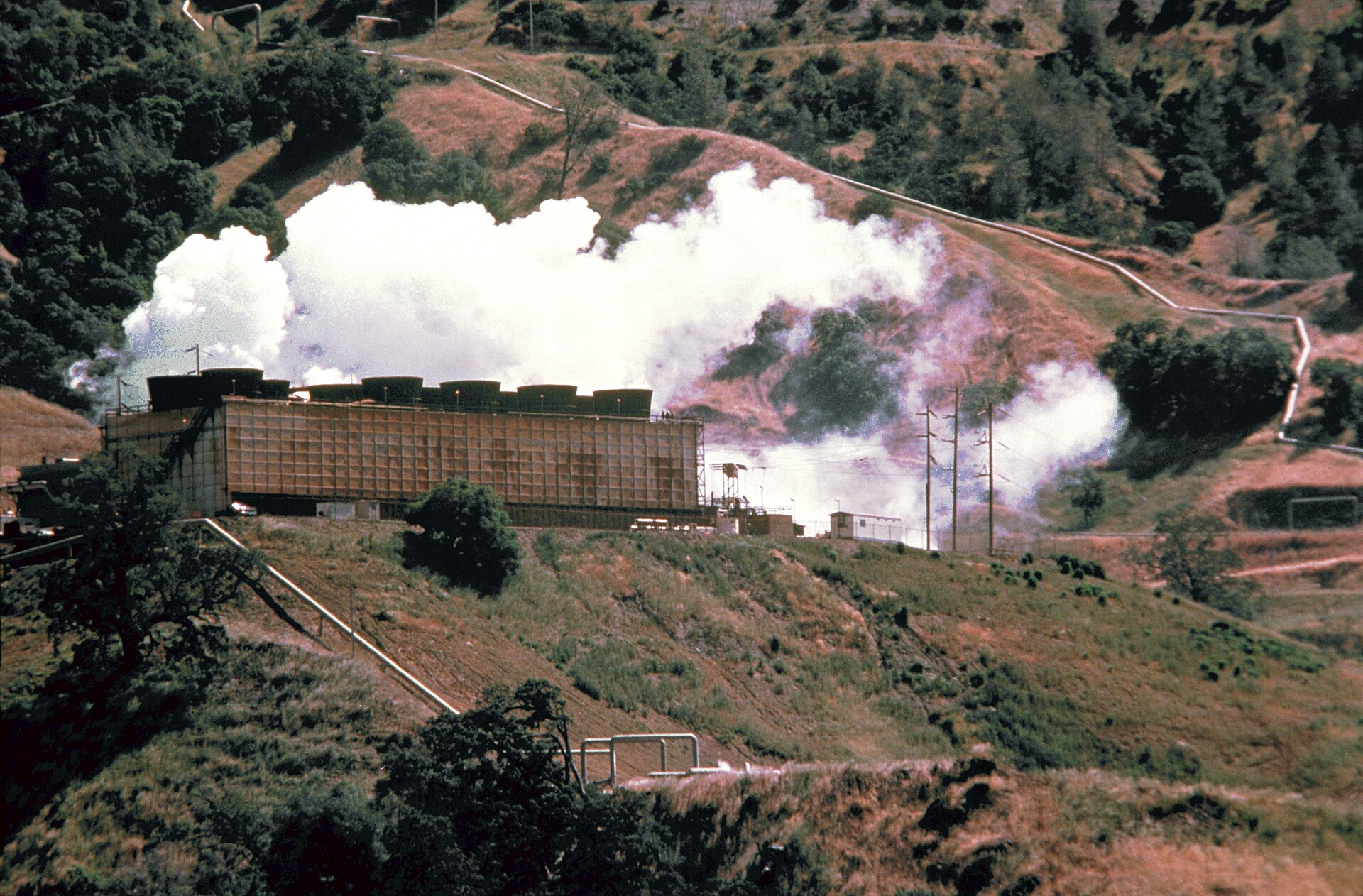
Photo: U.S. Department of Defense via Wikimedia Commons, public domain
Quick Answer: Texas geothermal energy in 2026 rests on laws passed in 2023 and 2025: landowners own the heat beneath their land, and the Railroad Commission of Texas regulates geothermal wells. The Commission has issued two deep geopressured geothermal storage permits, to Sage Geosystems in Atascosa County and Quidnet Energy in Galveston County. Shallow closed-loop wells for heating and cooling have more than doubled this fiscal year to 3,162 wells at 39 sites.
Geothermal has moved from a research topic to a regulated and financed corner of the Texas energy business. The state’s oil and gas regulator now oversees geothermal wells, Houston hosts some of the sector’s best-funded developers, and a research group has proposed a state loan fund for early exploration. Still, geothermal capacity built for the ERCOT grid is measured in single megawatts, and much of the money raised by Texas-based companies is going to projects in other states.
Who regulates geothermal energy in Texas?
The Railroad Commission of Texas (RRC) regulates geothermal wells. That authority came from Senate Bill 786, authored by Sen. Birdwell and passed by the 88th Legislature in 2023. Before the bill, the Texas Commission on Environmental Quality (TCEQ) and the RRC both had authority over closed-loop geothermal injection wells. The bill’s sponsor said the change “would provide certainty to potential operators seeking to produce geothermal energy.”
SB 786 added Section 27.037 to the Water Code. It gives the RRC authority to issue individual permits, general permits or permits by rule, bars drilling without an RRC permit, and classifies the wells as Class V wells under the RRC’s underground injection control program. TCEQ’s related rules, records and appropriations moved to the RRC. The law took effect September 1, 2023.
Who owns geothermal heat under Texas land?
Senate Bill 785, also from 2023, settled whether geothermal energy belongs to the surface owner or the mineral estate owner. It sides with the landowner. Where surface and mineral estates have been severed, the surface owner holds the geothermal resource unless a deed, lease or other agreement says otherwise. The law excludes minerals dissolved in groundwater, including hot brines. It leaves existing law on oil, gas, mineral extraction and groundwater unchanged. It also lets title insurers except geothermal interests from coverage, as they can with mineral estates.
What did the 2025 Texas Legislature change for geothermal?
The 89th Legislature passed three geothermal bills in 2025, and Gov. Greg Abbott signed all three.
SB 879: relief for shallow closed-loop wells
After SB 786 took effect, the RRC found that shallow closed-loop wells authorized by permit by rule faced financial assurance and filing requirements designed for larger hydrocarbon wells. The sponsor argued these wells resemble water wells. SB 879 exempts their operators from filing an RRC Form P-5 organization report and from paying the drilling permit fee. It took effect September 1, 2025.
SB 1762: geothermal and the Texas Energy Fund
SB 1762 makes geothermal generation and geothermal-based storage eligible for Texas Energy Fund support. It defines geothermal energy conservation wells as “wells used for the retention of energy” and places them under Utilities Code provisions requiring dispatchability during low grid reserves. The Fund’s completion bonus pays $120,000 per megawatt for projects interconnected before June 1, 2026, and $80,000 per megawatt for those interconnected from then through June 1, 2029. The bill took effect immediately.
HB 4370: thermal networks as public improvements
HB 4370 designates geothermal water conveyance facilities as public improvement projects. Cities, water districts and special-purpose districts can now finance them, including thermal energy networks, through public bonds and public-private partnerships. It took effect September 1, 2025. HB 3240, which would have created a Geothermal Energy Council, did not advance.
| Bill | Session | What it does | Effective |
|---|---|---|---|
| SB 785 | 2023 | Geothermal ownership goes to the landowner, or surface owner if estates are severed | By Sept. 1, 2023 |
| SB 786 | 2023 | Moves closed-loop injection wells from TCEQ to RRC | Sept. 1, 2023 |
| SB 879 | 2025 | Waives P-5 filing and permit fee for shallow closed-loop wells | Sept. 1, 2025 |
| SB 1762 | 2025 | Makes geothermal eligible for Texas Energy Fund support | On signing |
| HB 4370 | 2025 | Local financing for geothermal water conveyance and thermal networks | Sept. 1, 2025 |
How many geothermal permits has the Railroad Commission issued?
On July 30, 2026, the RRC announced its second permit for a deep geopressured geothermal well. It went to Quidnet Energy Deployment LLC for a storage well in Galveston County. The first, issued in February 2025, went to Sage Geosystems for a well in Atascosa County supporting San Miguel Electric Cooperative. The agency says geothermal drilling resembles oil and gas practice, which is why it applies its existing oversight. Executive Director Wei Wang said the RRC has taken a “deliberate permitting approach.”
How fast is shallow geothermal growing?
Shallow closed-loop systems, which use the earth as a heat sink to heat and cool buildings, account for most geothermal wells by count. The RRC reports about 1,400 completions in each of fiscal years 2024 and 2025. In the current fiscal year, the count has more than doubled to 3,162 wells at 39 sites, with local school districts among the adopters. The agency says a new shallow geothermal rule streamlined permitting without added staff or higher fees.
| Texas geothermal snapshot | Figure |
|---|---|
| Lead regulator | Railroad Commission of Texas (since Sept. 2023) |
| Deep geopressured permits | 2 (Sage, Feb. 2025; Quidnet, July 2026) |
| Shallow wells, FY2024 and FY2025 | About 1,400 per year |
| Shallow wells, current fiscal year | 3,162 at 39 sites |
| Sage SMECI Well #1 | 3 MW, 4-6 hours, Atascosa County |
| Technical power potential (Project InnerSpace) | About 140 GW |
| Fervo Energy IPO | $1.9 billion at $27 per share, May 2026 |
What is Sage Geosystems building in Texas?
Sage Geosystems, founded in 2020 and led by CEO Cindy Taff, has built the state’s most visible geothermal project. It first tested its approach in 2023 at an existing oil well in Starr County, reporting 200 kilowatts for more than 18 hours and 1 megawatt for 30 minutes, with up to 75% round-trip efficiency and water losses under 2%.
In August 2024, Sage and San Miguel Electric Cooperative (SMECI) announced a 3-megawatt system near Christine, on cooperative land next to SMECI’s 391-megawatt lignite plant. POWER magazine named it a Top Plant in September 2025, describing SMECI Well #1 as a 3-megawatt, 4- to 6-hour “pressure geothermal” system. Sage reported drilling, fracture stimulation, surface installation and commissioning complete by August 2025, about 12 months after funding approval.
How does pressure geothermal storage work?
When demand is low, grid power runs a pump that pushes water into an engineered fracture deep underground, which expands and stores pressure. When demand rises, the wellhead opens and the pressurized water drives a Pelton turbine. Sage targets 70% to 75% round-trip efficiency with no expected degradation, compared with 85% to 90% for lithium-ion batteries, which do degrade. The company says the approach suits low-permeability rock below about 5,000 feet, and that wells of 8,000 to 12,000 feet would cover roughly 90% of the U.S. for storage.
Is the Sage project connected to ERCOT?
Sage plans to run the well as a merchant asset, buying and selling power in ERCOT’s South Load Zone. POWER reported in September 2025 that interconnection was slated for December 2025 and still pending. None of the sources reviewed for this article confirms a commercial operation date. The host site is also changing: POWER reported that SMECI sought USDA New ERA funding to replace its lignite unit with 400 MW of solar and 200 MW of batteries by 2027.
Where is Sage’s first commercial power plant?
In January 2026, Sage closed more than $97 million in Series B funding co-led by Ormat Technologies and Carbon Direct Capital, with Nabors among returning investors. Latitude Media put total funding above $114 million. The first commercial pressure geothermal power plant will be built at an existing Ormat plant in the western U.S., not in Texas. Sage also has a deal announced in August 2024 to supply up to 150 MW east of the Rocky Mountains for Meta’s data centers, targeted for 2027.
What other geothermal companies are tied to Texas?
Quidnet Energy
Houston-based Quidnet Energy, founded in 2013, holds the second deep permit. It pumps water into fractured shale, where rock stress pressurizes it, then flows it back through a turbine. In June 2024, the Journal of Petroleum Technology reported that Dallas-based Hunt Energy Network invested $10 million under a build-and-transfer deal targeting 300 MW of storage across Texas, which CEO Joe Zhou said could mean about 100 wells. Quidnet says one well could deliver 1 to 10 MW for 10 hours or longer. It also has an agreement with CPS Energy for up to 15 MW near San Antonio.
Exceed Geo Energy and Presidio
In May 2025, ThinkGeoEnergy reported that the Presidio Municipal Development District and Exceed Geo Energy formalized a 110-MW geothermal power purchase agreement. Presidio sits at the end of the line on the ERCOT grid and has had prolonged outages. The plan calls for an initial 9.9-MW phase, then expansion to 110 MW, with commercial operations expected by late 2026. A University of Texas Bureau of Economic Geology resource assessment preceded the deal. Exceed is also developing a 5-MW pilot with Austin Energy.
Fervo Energy
Houston-headquartered Fervo Energy, an enhanced geothermal developer, priced an upsized Nasdaq IPO in May 2026: 70 million shares at $27, raising $1.9 billion under the ticker FRVO, according to Renaissance Capital.
What do the economics of Texas geothermal look like?
Cost data remain scarce and mostly come from companies. Sage has said its storage should beat lithium-ion on levelized cost beyond about five hours of duration. It has cited a pilot levelized storage cost of 2 to 4 cents per kWh and a goal of about 9 cents per kWh for a pre-scale generation project. These are company claims, not audited results.
The broader case rests on the oil and gas supply chain. The 2023 report “The Future of Geothermal in Texas,” by researchers at five Texas universities, the University Lands Office and the International Energy Agency, found that transferring oil and gas technology could cut geothermal costs by 20% to 43%. Nearly 70% of oil and gas entities in the study said the industry could solve any geothermal technical challenge. Sage’s CEO has put Texas well permitting at two to three weeks.
What is the proposed Texas Geothermal Development Fund?
On November 17, 2026, Project InnerSpace and the Texas Geothermal Energy Alliance proposed a revolving state loan program for early-stage exploration. In their model, $400 million of state capital would deploy about $2 billion over 15 years and de-risk about 55 projects. The authors say that could unlock more than 30 GW of firm power, roughly one-third of Texas’s record peak demand. They also project up to $235 billion of private investment and $14 billion in state and local taxes. They say the plan needs no ratepayer charges, mandates or ERCOT market changes. These are the authors’ projections. They cite the $350 million Advanced Nuclear Development Fund, created in 2025, as a precedent.
What should Texas energy businesses watch next?
Four markers will show whether Texas geothermal moves beyond pilots. The first is an ERCOT commercial operation date for Sage’s Atascosa County well. The second is drilling at Quidnet’s Galveston County site, and the third is whether Presidio’s first 9.9-MW phase arrives on schedule. The fourth is whether the 90th Legislature takes up the development fund in 2027. Meanwhile, the RRC’s shallow well counts are the clearest leading indicator of demand, and they are rising fast.
Frequently Asked Questions
Who owns geothermal energy in Texas?
Under SB 785 (2023), the landowner does. If surface and mineral estates are severed, the surface owner holds it unless an agreement says otherwise.
Does the Railroad Commission or TCEQ permit geothermal wells?
The Railroad Commission, since SB 786 moved closed-loop injection well authority from TCEQ effective September 1, 2023.
Is there geothermal power on the ERCOT grid?
Sage built a 3-MW geothermal storage well in Atascosa County to trade in ERCOT’s South Load Zone. Its interconnection was slated for December 2025, and the sources reviewed do not confirm commercial operation.
Can geothermal projects get Texas Energy Fund money?
Yes. SB 1762 made geothermal generation and storage eligible, with a completion bonus of $120,000 or $80,000 per MW depending on interconnection date.
How many shallow geothermal wells are drilled in Texas?
About 1,400 a year in fiscal 2024 and 2025, and 3,162 at 39 sites in the current fiscal year, per the RRC.
Sources and Further Reading
- Geothermal Energy Gains Ground in Texas Under RRC Leadership — Railroad Commission of Texas
- Texas Railroad Commission issues second deep geothermal well permit — World Oil
- Bill Analyses for SB 785, SB 786 and SB 879 — Texas Legislature Online
- Geothermal Energy Efforts Get a Boost from Texas Legislature Bills — Pillsbury Winthrop Shaw Pittman
- Geothermal Breakthrough in South Texas Signals New Era for ERCOT — POWER Magazine
- Sage’s First 3-MW Geothermal Power and Energy Storage Project Will Feed ERCOT — POWER Magazine
- Sage Geosystems Raises Over $97 Million To Deploy World’s First Commercial Pressure Geothermal Power Generation Facility — Business Wire
- ERCOT’s first geothermal electrons are soon to arrive on the grid; Sage Geosystems’ plan to jump the commercialization line is underway — Latitude Media
- Quidnet Energy Finds Partner To Create Around 100 Energy Storage Wells in Texas — Journal of Petroleum Technology
- Exceed Geo Energy signs 110 MW geothermal PPA with Presidio, Texas — ThinkGeoEnergy
- Fervo Energy prices upsized IPO — Renaissance Capital
- The Future of Geothermal in Texas — University of Texas at Austin Energy Institute
- The Texas Geothermal Development Fund — Project InnerSpace and Texas Geothermal Energy Alliance