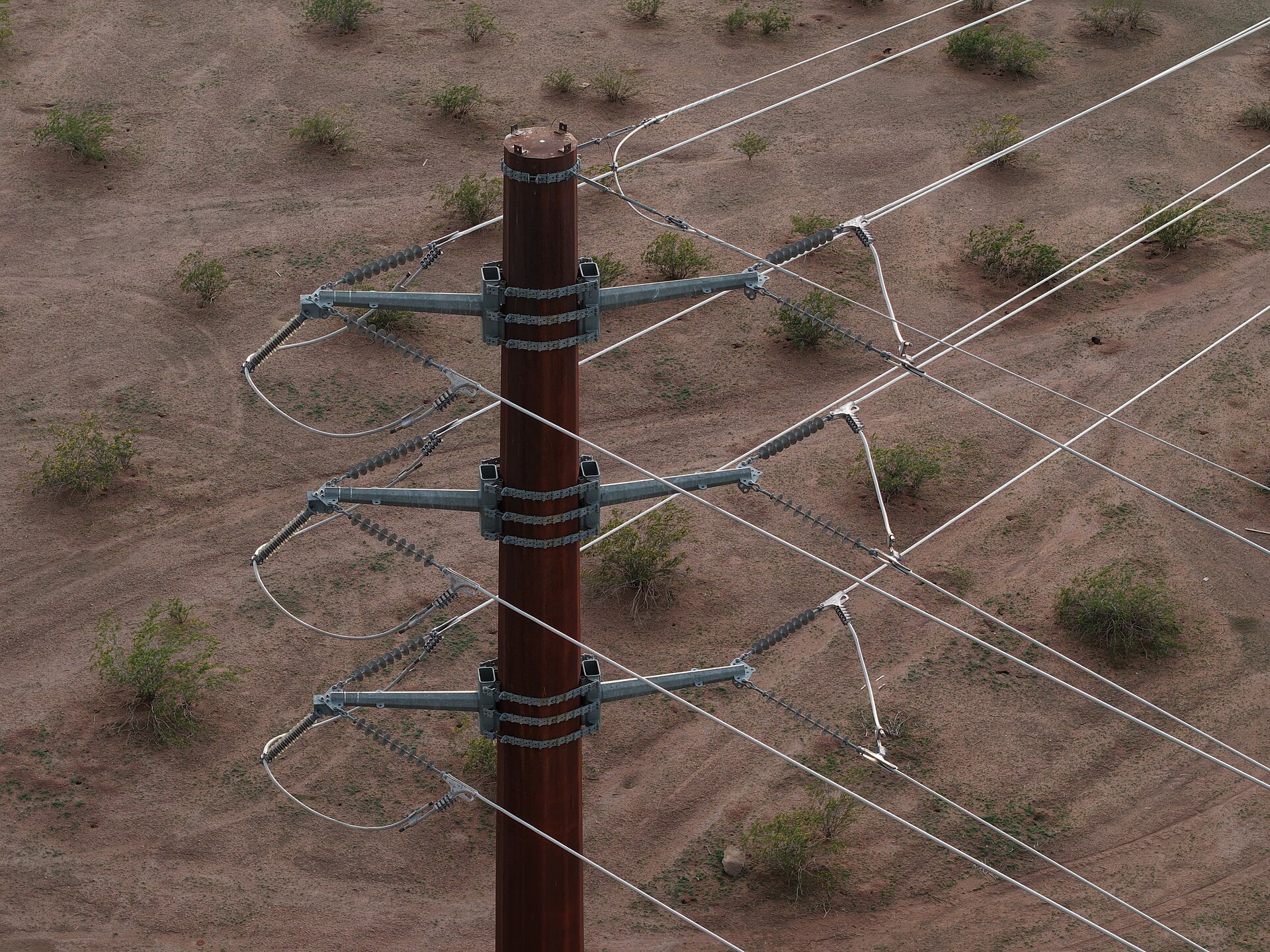
A tower carrying two sets of 69-kV transmission lines. Photo: Rsparks3 via Wikimedia Commons, CC0.
Quick Answer: As of November 2026, the Public Utility Commission of Texas has finalized nine Texas Energy Fund loans for new natural gas plants, totaling about 5,446 MW. Eight of those loans have published amounts, and they add up to about $3.52 billion at 3% over 20 years. Meanwhile, regulators are approving the 765-kV lines in the Permian Basin Reliability Plan, which was estimated at $13.8 billion when it was approved in 2024.
Where does the Texas Energy Fund stand in November 2026?
Texas voters approved the Texas Energy Fund (TxEF), created by SB 2627, through Proposition 7 on November 7, 2023. The fund now holds $9 billion through fiscal year 2028: $5 billion appropriated for FY2025–2026 and $4 billion for FY2027–2028. The Public Utility Commission of Texas (PUCT) runs four programs from it. The largest is the In-ERCOT Generation Loan Program. It offers 20-year loans at a fixed 3% interest rate, covers up to 60% of project cost, and is open to new or upgraded dispatchable plants that add at least 100 MW. The program is authorized to support up to 10,000 MW.
The most recent finalized loan was announced on October 8, 2026. It went to Pecos Power Plant LLC, a project company jointly owned by affiliates of Mercuria and Continental Resources, for a 452 MW gas plant in Reeves County. It was the ninth loan under the program. According to the PUCT and the Governor’s office, the plant will begin generating for ERCOT in 2027. Latham & Watkins, which advised the borrower, reported a term loan of about $459 million.
Which projects have received Texas Energy Fund loans?
| # | Project (sponsor) | Location | MW | Loan | Announced | Expected online |
|---|---|---|---|---|---|---|
| 1 | Rock Island (Kerrville Public Utility Board) | Colorado County | 122 | Up to $105M | June 2025 | By June 1, 2027 |
| 2 | TH Wharton (NRG) | Houston load zone | 456 | Up to $216M | Aug. 2025 | Summer 2026 (NRG target) |
| 3 | Cedar Bayou (NRG) | Chambers County | 721 | $562M | Sept. 26, 2025 | Summer 2028 |
| 4 | Pin Oak (Calpine, now Constellation) | Freestone County | 460 | $278.3M | Oct. 14, 2025 | Online May 5, 2026 |
| 5 | Basin Ranch (CPV) | Ward County | 1,350 | $1.12B | Oct. 30, 2025 | 2029 |
| 6 | Greens Bayou (NRG) | Harris County | 455 | Up to $370M | Nov. 2025 | 2028 |
| 7 | Rayburn Energy Station II (Rayburn Electric Cooperative) | Sherman | 570 | Up to $411M | June 4, 2026 | 2028 |
| 8 | Permian Basin Power Plant expansion (Vistra) | Ward County | 860 | Not disclosed | June 24, 2026 | 2028 |
| 9 | Pecos Power Plant (Mercuria / Continental Resources) | Reeves County | 452 | ~$459M | Oct. 8, 2026 | 2027 |
| Total | 5,446 | ~$3.52B (8 disclosed) |
Source: Office of the Texas Governor loan announcements (June 2025–October 2026); POWER Magazine (Nov. 2025); NRG via Gas Processing & LNG (Aug. 2025); Industrial Info Resources (May 2026); Latham & Watkins (Oct. 2026). Totals are EnergyNewsTexas calculations from the listed figures.
The capacity total checks out against outside reporting. In October 2026, BIC Magazine reported that the eight loans before Pecos added up to 4,994 MW. Adding Pecos’s 452 MW gives the 5,446 MW shown above, or about 54% of the program’s 10,000 MW authorization. The dollar total is incomplete because the state’s announcement of Vistra’s 860 MW loan did not include an amount.
How many projects dropped out, and what does that tell us?
In summer 2024, developers filed more than 70 applications covering more than 38 GW. In August 2024, the PUCT advanced 17 projects to due diligence. Together they totaled 9.7 GW and requested $5.38 billion in loans, according to Latitude Media. Since then, the pipeline has narrowed sharply.
| Announcement | Loans finalized | Applications still pending | Pending MW |
|---|---|---|---|
| Aug. 2024 (due-diligence list) | 0 | 17 | ~9,700 |
| Sept. 26, 2025 | 3 | 14 | 7,671 |
| Oct. 30, 2025 | 5 | 12 | 5,861 |
| Nov. 2025 | 6 | 11 | 5,406 |
| June 4, 2026 | 7 | 6 | 3,216 |
| June 24, 2026 | 8 | 5 | 2,356 |
Source: Office of the Texas Governor and PUCT loan announcements, September 2025–June 2026; Latitude Media (Nov. 2025) for the August 2024 baseline. Pending figures are as stated in each announcement.
Some projects moved from the pending column to the finalized one, but others withdrew. In September 2025, the Texas Tribune counted seven withdrawn applications, with companies citing adverse market conditions. By early November 2025, Latitude Media counted at least eight withdrawals, representing about 35% of the capacity originally proposed. Withdrawals included Engie (two projects, citing equipment constraints) and WattBridge (four projects, citing high costs and delays). The Legislature let the PUCT extend loan disbursements past the original December 31, 2025 deadline.
Why are gas plants harder to build than the fund expected?
The constraint is the cost of building plants, not the cost of borrowing. Analysts quoted by Latitude Media pointed to tight gas-turbine supply and high turbine prices, driven largely by data center demand. They also cited limited engineering and construction capacity, inflation and tariffs, and ERCOT forward power prices that have not risen enough to support the hedges needed for a final investment decision. Brent Nelson of Ascend Analytics said many approved projects were already in development as early as 2020. He estimated costs for most new projects at close to $2,500 per kW. By comparison, NRG’s Cedar Bayou costs about $800 per kW because it began interconnection in 2022 and already had turbines on site.
Disclosed budgets support that view: Pin Oak works out to about $1,009 per kW ($464 million for 460 MW), CPV’s Basin Ranch to about $1,393 per kW ($1.88 billion for 1,350 MW), and Rayburn to under about $1,202 per kW (under $685 million for 570 MW). All are well below Ascend’s roughly $2,500 per kW figure, so the plants that closed loans were mostly ones that had locked in costs early.
What else is the Texas Energy Fund paying for?
Loans are not the only tool. The PUCT also runs a Completion Bonus Grant program for dispatchable plants of at least 100 MW that connect to ERCOT before June 1, 2029. Grants are worth $120,000 per MW for plants connected before June 1, 2026, and $80,000 per MW for plants connected from then until June 1, 2029. They are paid over 10 years. Each year’s payment depends on the plant’s availability compared with other thermal units; plants at or below the median receive nothing that year.
The first grant agreement went to LCRA’s Timmerman Unit 1 near Maxwell in Caldwell County. The unit has about 186–190 MW of reciprocating-engine capacity and entered service on August 20, 2025. Its grant is worth up to $22.56 million, paid as up to $2.256 million a year. The first performance test period runs from June 1, 2026, to May 31, 2027. As of late 2025, the PUCT had also committed $621.65 million to 10 reliability projects outside ERCOT.
Have any loan-backed plants started running yet?
Yes. According to Industrial Info Resources, the 460 MW Pin Oak peaking plant in Freestone County entered service on May 5, 2026. It was the first TxEF-backed plant to begin operating, financed with the $278 million fourth loan. The Kerrville utility’s 122 MW Rock Island project has a target date of June 1, 2027. Most of the remaining loan-backed capacity is scheduled for 2027–2029.
How much will the Permian Basin’s 765-kV transmission cost?
The power plants are only part of the bill. On September 26, 2024, the PUCT approved the Permian Basin Reliability Plan. It chose a 765-kV design estimated at about $13.8 billion, including local upgrades, to serve forecast load in 2038. The 345-kV alternative was estimated at about $12.95 billion, about $850 million less. The plan calls for eight new import paths into the Permian Basin: five at 345 kV and three at 765 kV. Commissioner Jimmy Glotfelty estimated West Texas congestion costs at $100 million to $300 million a year, which he said could help pay for the lines.
| Item | Figure |
|---|---|
| 765-kV plan cost estimate (incl. local upgrades) | ~$13.8 billion |
| 345-kV alternative estimate | ~$12.95 billion |
| New import paths | 8 (five 345-kV, three 765-kV) |
| Permian load forecast, 2030 / 2038 | 23,659 MW / 26,400 MW |
| 765-kV need begins | 2030 |
| Estimated West Texas congestion cost | $100M–$300M per year |
| TxEF gas units in West Load Zone modeled in 2025 RTP | 17 units at six sites |
Source: Utility Dive (Sept. 2024) and Transformer Magazine on the PUCT approval; ERCOT letter to Rep. Charlie Geren, August 12, 2026.
Which 765-kV lines have regulators approved?
The certification phase moved forward in 2026. On August 28, 2026, the PUCT unanimously approved two Oncor 765-kV lines into the Permian Basin. One runs southwest from Bosque County, and the other runs northwest from the San Antonio area. Together they cross at least 30 counties. At that meeting, commissioners tabled the Howard–Solstice line. AEP Transmission’s project page now shows a PUCT final order dated September 18, 2026, for that line. It runs about 370 miles from AEP Texas’ Solstice Substation near Fort Stockton to CPS Energy’s Howard Substation southwest of San Antonio. Lieutenant Governor Dan Patrick and several lawmakers have said they want changes to the transmission approval process in the 2027 session.
Why does ERCOT say the lines are needed now?
In an August 12, 2026, letter to Rep. Charlie Geren, ERCOT’s D. Woody Rickerson said three separate studies identified a need for 765-kV additions starting in 2030. Those studies were the July 2024 Permian Basin plan, the 2024 Regional Transmission Plan and the 2025 Regional Transmission Plan. The letter said the need appeared in every load scenario studied. The letter also connects the two programs. The 2025 plan included 17 TxEF-backed gas units at six sites in the West Load Zone. Three of the nine finalized loans, totaling 2,662 MW, are for plants in Ward and Reeves counties. Those plants need transmission capacity to deliver power to customers.
Brian’s Take
The Texas Energy Fund shows that cheap money cannot fix every problem. The state offers 3% loans for 20 years, covering up to 60% of a project, yet only nine loans have closed, and about a third of the originally proposed capacity had dropped out by late 2025. The projects that did close mostly locked in their costs early. Cedar Bayou costs about $800 per kW, compared with about $2,500 per kW for a typical new project today. That tells me the fund has mostly sped up projects that were already underway rather than creating new ones.
That isn’t a failure. More than 5,400 MW of dispatchable capacity is a real addition, and Pin Oak is already running. Still, anyone watching Texas power costs should keep two separate bills in mind. The loans are expected to be repaid. The roughly $13.8 billion Permian transmission plan will be paid for differently, and the plants in Ward and Reeves counties depend on it. If the Legislature changes the transmission approval process in 2027, the schedule for those gas plants is at risk too. I would treat the plants and the transmission lines as one combined investment, not two.
Frequently Asked Questions
How many Texas Energy Fund loans have been approved?
Nine loans under the In-ERCOT Generation Loan Program had been finalized as of November 2026. The most recent was the 452 MW Pecos Power Plant in Reeves County, announced on October 8, 2026.
How much money is in the Texas Energy Fund?
The fund holds $9 billion through FY2028: $5 billion for FY2025–2026 and $4 billion for FY2027–2028. It is spread across four PUCT programs.
How much does the Permian Basin 765-kV plan cost?
When the PUCT approved the plan in September 2024, it estimated the 765-kV option at about $13.8 billion, including local upgrades. The 345-kV alternative was estimated at about $12.95 billion.
What are the terms of a Texas Energy Fund loan?
The In-ERCOT program offers 20-year loans at a fixed 3% interest rate, covering up to 60% of project cost, for new or upgraded dispatchable plants that add at least 100 MW.
Sources and Further Reading
- Governor Abbott Announces Texas Energy Fund Loan For 860 MW Of New Power In West Texas (June 24, 2026) — Office of the Texas Governor
- Governor Abbott Announces Texas Energy Fund Loan For 570 MW North Texas Natural Gas Power Plant (June 4, 2026) — Office of the Texas Governor
- Governor Abbott Announces Texas Energy Fund Loan To 1,350 MW West Texas Natural Gas Power Plant (Oct. 30, 2025) — Office of the Texas Governor
- Governor Abbott Announces Texas Energy Fund Loan To 721 MW Natural Gas Facility In Southeast Texas (Sept. 26, 2025) — Office of the Texas Governor
- Governor Abbott Announces First Texas Energy Fund Loan To 122 MW Natural Gas Facility (June 26, 2025) — Office of the Texas Governor
- Texas Issues First Performance-Based Grant Under Energy Fund for LCRA’s New 188-MW Rice Peaker — POWER Magazine
- Governor of Texas Announces Sixth Texas Energy Fund Loan Agreement for 455 MW Natural Gas Power Plant in Houston — T&D World
- Texas Governor Announces Loan for 460 MW Natural Gas Facility — American Public Power Association
- NRG Closes on Texas Energy Fund Loan for 456-MW Natural Gas Generation Project — Gas Processing & LNG
- Latham Advises on Texas Energy Fund Financing of 452 MW Pecos Power Plant (Oct. 2026) — Latham & Watkins
- Texas Approves Funding for Natural Gas Power Plant in Reeves County (Oct. 2026) — BIC Magazine
- First Texas Energy Fund-backed Generation Project Comes Online (May 2026) — Industrial Info Resources
- How the Data Center Boom Brought Down the Texas Energy Fund (Nov. 2025) — Latitude Media
- State Approves $562 Million Texas Energy Fund Loan for Power Plant Near Baytown (Sept. 2025) — The Texas Tribune
- Texas Regulators Approve Permian Basin Reliability Plan (Sept. 2024) — Utility Dive
- Texas Approves $13.8 B Plan for Permian Basin Grid — Transformer Magazine
- Response to Rep. Charlie Geren (Aug. 12, 2026) — ERCOT
- Texas Regulators Approve Two Massive West Texas Transmission Lines (Aug. 28, 2026) — KSAT
- Howard–Solstice Transmission Line Project — AEP Transmission